Showing posts with label Year In Review. Show all posts

Saturday, June 29, 2019

Y1 Year in Review (2018-2019)

General Remarks

Justin has a September birthday, and we opted to start him in 1st grade, or Form 1B this school year.  I'm glad he had that additional year to settle a bit more, as I think we had a much more successful year this way than we would have if we had started him a year earlier.  

Justin, in some ways, is like Gregory in that he loves outdoor projects, tools, and working with people on projects.  He has a more affectionate nature though, and he is also our "crazy monkey boy" as we sometimes call him.  He's shot up quite a bit this year, and often seems all arms and legs, especially when he capers around the house, making noise and generally annoying everyone older than himself. 

Justin and Hannah are best buddies, and do just about everything together.  Hannah and Justin both told people that they were in Kindergarten and First Grade, because they do everything together.  Hannah was present for much of the work below, but would often wander away during the more skill oriented subjects like math, copywork, and reading practice.  But sometimes she would do it on her own at the table with us, writing very carefully whatever she wanted to write in pink or purple pen in her notebook or setting out manipulatives and creating her own equations.

I feel like a Mason education is such a gift for a boy like Justin.  Short lessons hold his attention, the breadth of studies keeps him interested, and the overall short day gives him lots of time to build and play outside.  He also benefits from separating the work of the mind from the development of skills like reading and writing.  His mind is fed with all sorts of ideas from a variety of books, even though his reading progress, while still definitely progress, is slow.


Subject Areas

Bible/Faith

3x/wk, 20 min - Old Testament Studies:  1 and 2 Samuel, 1 and 2 Kings

I do this subject with Gregory, Nathan, and Justin and read the Bible text aloud.  Everyone narrates, and we do appropriate map work afterwards.

On most evenings, Justin and Hannah have a Bible story read aloud to them.  This is probably their third time through Egermeir's Bible Story Book, and their 6th time through a Bible story book in general.  Egermeir's, even though it isn't Catholic, still remains my favorite Bible story book because I feel like she has just the right level of detail and I generally like the quality of her writing.  The illustrations aren't amazing, but they are decent and definitely not cartoonish.

Language Arts

Building the habit of narration is of course a huge part of starting a student in a Mason education.  And having heard his siblings narrate all his life, narration was natural and easy for Justin.  He narrates fairly well, but often lets himself get distracted in his narration by all the life that is going on around him.

Justin does copywork in print 5x/wk for about 6-10 minutes.  I've used poetry, nursery rhymes, sentences from his reading, and a short story I made up for him so that he could get more practice writing the names of people in his family.

Justin does reading practice 5x/week for about 15 minutes and we largely work with a moveable alphabet, poetry/nursery rhymes, and his word book.  At the beginning of the year I was generally slogging through simple readers, but after re-reading Mason's section on reading instruction in Vol. 1, I stopped the madness and went back to her much more effective and pleasant method.  I found this quote particularly convicting:
Now, compare the steady progress and constant interest and liveliness of such lessons with the deadly weariness of the ordinary reading lesson. The child blunders through a page or two in a dreary monotone without expression, with imperfect enunciation. He comes to a word he does not know, and he spells it; that throws no light on the subject, and he is told the word: he repeats it, but as he has made no mental effort to secure the word, the next time he meets with it the same process is gone through. The reading lesson for that day comes to an end. The pupil has been miserably bored, and has not acquired one new word. Eventually, he learns to read, somehow, by mere dint of repetition; but consider what an abuse of his intelligence is a system of teaching which makes him undergo daily labour with little or no result, and gives him a distaste for books before he has learned to use them. (Vol. 1, p. 206-207)
I don't know why I had reverted to such an ineffective method, but I think it serves as an excellent reminder as to why it is so important to keep studying and reading Mason's work and the Parent's Review articles.  Just because you've read how to do something once, or even because you were doing something using Mason's methods in the past doesn't mean you will automatically continue to do it that way in the future.  It is so easy to drift back to what we grew up with or what we started homeschooling with, even if we completely do not intend to do so!


Mathematics

I was fortunate enough to go to Sonya Shafer's presentation about Living Math in 2016 and I bought the Living Math book and DVD.  I was so impressed by what she presented, that I knew this was the way to go.  I implemented some of the strategies with my two older sons and it made a huge difference for them.  I was excited to start from the beginning using these living math methods with my younger children.

I purchased Book 1 of the Charlotte Mason Elementary Arithmetic series right when it came out, but I was at a bit of a loss as to where to start with it.  It starts at the very beginning, like the student has never seen a number before or ever thought of counting anything.  That certainly doesn't describe Justin, so I put it aside and we played lots of number games with these great dot cards, used money, practiced counting by two's, three's, five's and ten's using different objects, wrote numbers and equations, and played lots of different games where we made 10's. Justin grew very solid on adding and subtracting into the teens, and I decided it was time to push into tens bundles.  I took another look at the Elementary Arithmetic book and decided to start using that in the Twenty through Twenty-Nine section about halfway through the book.  We transitioned smoothly over to this, and while Justin still misses the dot cards upon occasion, this is more appropriate for him and is helping him to progress further in his mathematical learning.


Literature

While I was planning, I had this brilliant idea that I would have three literature slots, each about 20 minutes.  In one slot I would read from Fairy Tales (I chose an illustrated Andersen's Fairy Tales), and in the second I would read from a rotation of Just So Stories, Beautiful Stories from Shakespeare, and Aesop's Fables.  We would read from one until we finished a story, then move to the next book.  That way we would be reading just a few fables a term and we could still read from these other two literature books I wanted to include in his curriculum.  It was a great idea, but it just didn't have enough reading time in the schedule to make it work well.  Each Just So Story would take 2-3 weeks, and a story from Beautiful Stories from Shakespeare could take 4-6 weeks, which meant that we sometimes only made it through one rotation in a term.  In the third slot I read Velveteen Rabbit, King of the Golden River, and Peter Pan. (although Peter Pan got moved to Morning Time because I realized the other kids were all trying to listen in while pretending to do other lessons)

I'd like to revisit the idea of a literature rotation slot next year, but I need to think about how to implement it better.  I think it is better to just read a handful of fables in a term, and this helps me to remember to read them periodically...  but I would like to be reading more than 3-4 per year!

History

Since Justin is in Form 1B, he was not included in our history rotation.  He'll join us for history next year when he enters Form 1A.  This year his focus was on heroic tales from early America.  He had three history slots, each about 15 minutes.

I also read to him from 50 Famous Stories, because I love that book and have used it with his three older siblings.  It feels like a quintessential Form 1 book to me and is always well received.  It proved a favorite with Justin as well, and I'm glad I included it in the curriculum.


Geography

Practical Geography
We read Me On the Map at the beginning of the year, and did lots of work on finding the cardinal directions, observing shadows at different times of day, discussing where the sun rises and sets...  very basic orienteering sort of work.  

In any reading of Justin's that had a geographical component, we would study the globe and find where we live, then find the place we were reading about.  We would do the same thing with our large US wall map.

Cultural Geography
In the half of the year we read the first three books, and referred often to the map to discuss where these children lived.  I felt like the literary quality was lacking though, and they didn't create vivid images of the places they were describing.  I had hesitated to use Little Folks because it isn't a particularly accurate representation of how things are now in various places, but the writing is so much more vivid that I decided to give it a try.  It quickly became a favorite, and I'm glad I switched over.  

Natural History

We were a little light in Natural History this year, although we do read nature lore as part of our family studies.  We read once a week from the following:


Spanish

We spent about 10 minutes a day on Spanish and I focused on colors, numbers, parts of the body, very basic sentences, and some common animals and objects in our Spanish studies.  We also sing Spanish folk songs as part of our family studies.

For our lessons, I used Oso Pardo, Oso Pardo, qué ves ahí (and used Erin's very helpful videos on YouTube), cards with the animals in the colors from the book, basic questions like "Cuantos libros hay sobre la mesa?", "Toque tu cabeza", "Dondé está la silla?", etc. for our practice.  It was very interactive, and Justin could generally understand what I was saying by the end of the year, and can come up with words and sometimes even sentences to respond.  So, progress!  But I'm looking forward to moving him to The ULAT so that it doesn't take quite so much out of me.

Handicrafts

Justin has been working on sewing, weaving, and knitting for handicrafts this year.  He's also started Sloyd, and is on the 9th project in the first year.  We generally make each project 2-3 times, in different weights of paper.  I had hoped to do Sloyd with him every week, but I think it was more like 3 out of every 4 weeks.


Music

Justin has started piano lessons with Hoffman Academy.  He is doing well with it, and is about halfway through the second unit.  He does a new lesson about once a week, and I usually have him do some practice before doing the practice session on the website.  He's making good progress, and enjoys playing the piano.  He will even come to the piano and play some of his songs when it isn't time to practice, which I consider a good sign.  I generally watch the lessons with him as well as sit with him for the 10 minutes or so that he practices each weekday.

Drawing

I need to do brush drawing lessons with Justin, but it didn't happen this year.  I did have Justin do a couple drawings from how to draw books to share at our Family Keeping Meeting each week and that has helped his drawing ability and fine motor skills.  I also did art lessons with him sporadically, generally from Masterpiece Society.  This is an area where I definitely need to improve as a teacher!

Family Studies

I should probably mention that there are other subjects in a Mason education, but we study those together as a family.

Y5 Year in Review (2018-2019)

General Remarks

Nathan is the youngest of what we think of our older set of kids, and is not quite sure he wants the responsibility of being one of the older kids.  But he definitely wants the privileges, so there's often a struggle between wanting the privileges but not wanting to step up to the responsibilities.  

Nathan really values time alone, which is challenging when you are 3rd in a family of 6 kids.  He also is required to share a room with 2 brothers, but at least he has a top bunk which gives him a little bit of personal space.  Nathan has a deep caring streak, doting on his beloved guinea pigs and often attending with great kindness to his baby sister.  He'd much rather be on "Charlotte Duty" than do any other sort of household work.  He loves to read and play Legos and would happily do that day after day after day if allowed to do so.  He's interested in cooking, but often the thought of clean-up is enough to keep him from doing it.  He is our chief lizard catcher and is the one most interested in catching and observing the various critters who live around here.

Nathan's my child that I really wonder what his "bent leather" will end up being.  I feel like there's a lot of different possibilities, but I also have a suspicion that whatever it is will end up being one of those things that is obvious in retrospect but surprising when it happens.  In the meantime, we keep trying to initiate a large number of relationships with different ideas and things so as to prepare him for whatever kind of work is before him in the future.


Subject Areas


Bible/Faith

3x/wk, 20 min - Old Testament Studies:  1 and 2 Samuel, 1 and 2 Kings

I do this subject with Gregory, Nathan, and Justin and read the Bible text aloud.  Everyone narrates, and we do appropriate map work and lists of kings and prophets afterwards.

5x/wk, 10 min - New Testament Studies:  Nathan reads from the Gospels on his own.

1x/wk - Devotional Reading:  The Curé of Ars, The First Christians, My Path to Heaven

Language Arts

Nathan has moved to three compositions a week, and I would generally type one of them for him.  Getting Nathan to write is definitely a struggle, and compositions are the most dreaded part of his school week.  He's made good progress this year though, as his compositions have gotten fuller and more detailed.  But if he put as much effort into doing his compositions as he does into complaining about them, he'd be in a much better place with his writing.

Gregory and Nathan do dictation together 4x/wk, and Nathan does copywork daily for about 10 minutes.  I've changed how I am doing dictation thanks to Celeste Cruz's dictation immersion at CM West :: Retreat in Old San Juan and that has greatly increased the rate of improvement.

Nathan finished up the first level of Winston Grammar this year (which he started last year) and has definitely made progress.  I think adding Latin this year (I'll talk about that further down) was beneficial for him, and has helped him to get a better grasp of the parts of speech.  Next year Nathan will start the Analytical Grammar Jr. Mechanics book.


Mathematics

Nathan is working in the Strayer-Upton Practical Arithmetics Book 2.  I work with him every day and we do not do every page.  This year we've focused on fractions, while also keeping the long division and multiplication fresh in his mind.  Because he saw Gregory working in it and thought it looked interesting, we work about 1x/wk with Hands-On Equations.  I wasn't sure how he'd do with it, but he's taken to it very well and understand the concepts quickly.  We also work 1x/wk in Lessons in Experimental and Practical Geometry, and another 1x/wk doing game-based arithmetic practice, generally with Gregory.

In general, I like the multi-stream approach to mathematics, but sometimes I feel like our we're a little too scattered.  But he's making progress and generally understanding well, and that's what is really important.

Literature

Nathan read The Aeneid for Boys and Girls for the first half of this year, which had the added benefit of allowing him to join the family in our Aeneid discussions.  He liked the fact that he was moving through the story more quickly than we were too.

Nathan also read some of Kim this year, and I think he'll finish it over the summer.

I feel like Nathan's scheduling was a little light in literature and a little too heavy in historical fiction, but I think it was a good choice for this student for this year.  Last summer just about all Nathan wanted to read was Redwall, so I thought assigning more historical fiction might spark interest in that direction.  This has completely succeeded, and now his free reading is far more broad than it was a year ago.  And it isn't just historical books, but other more literary childhood classics as well.

History

This year we were studying the 19th Century in European and American History, and Ancient Rome in our Ancients stream.

American History


English History


Ancient History


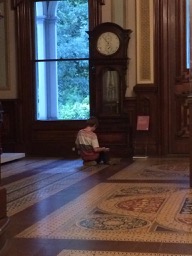
Drawing the clock at the Crocker Art Museum

Citizenship


Nathan also joined us for Plutarch as part of our family studies.

Geography


  • Our Country and Its People by Buckbee - I thought this went reasonably well, although I need to work more with the maps and in setting up the lesson.
  • Book of Marvels, The Occident - another favorite (and really, who doesn't love Richard Halliburton?  And isn't it wonderful to have this back in print?).  Nathan read, narrated, and added locations to his map for this book. 
  • Mapping the World with Art - 1x/week I did a map drawing exercise from this book with Gregory and Nathan.  I really like how the author breaks down and explains how to draw the various parts of the world.  

Natural History

Last year Nathan and Gregory their science together, but this year I split them as Gregory moved into Form 3.  Each term had a general Natural History book, a book about Inventions, and then a theme for the term.  There were 2 20 minute slots and 1 30 minute slot each week.

Term 1:  Great Inventors and Their InventionsStorybook of Science (continued from last year) and Junior Science Book of Electricity with Snap Circuit challenges
Term 2:  Great Inventors and Their Inventions, Storybook of Science (finished) and Rain, Hail, Sleet & Snow (I didn't use the study guide w/ experiments because I just didn't have time to do that with him that term.  I thought the book was rather light, but it probably would have been better with the guide)
Term 3:  Great Inventors and Their Inventions, The Life of a Spider by Fabre and From Shore to Ocean Floor (I got some great narrations from this book)

Latin

We used Getting Started with Latin and I really like this book.  Nathan generally did too, which was great.  We did it all orally, where I would read the sentence in Latin, Nathan would repeat it in Latin, then translate it into English.  I really like the format of the book and the pacing.  There was a lot of review in the book, but there was enough variation that it didn't feel like drudgery.  And introducing just one new word each lesson made the vocabulary building feel painless.

I'm so glad to have finally found a good way to ease students into Latin!

Spanish

This is the first year that I feel like we've actually made some solid, if slow, progress in Spanish!  It has been part of our curriculum for years, but it wasn't something that the boys enjoyed and no one was learning much.  We started using theulat.com and, finally, progress is happening!  We aren't spending as much time on it as we should, and there's still definitely some serious foot dragging happening here, but still... progress!!  I think what Steve Nesbitt has created in the ULAT is absolutely brilliant, and I am so impressed by his program.  We also learn folk songs and poetry in Spanish as part of our family studies.

Handicrafts

If only Legos could count as handicrafts, Nathan would be a very happy boy.  As it is though...  Nathan has been learning to knit this year, and does still like to whittle and build with his brother.  Nathan is also in the second year of the Paper Sloyd book and probably could benefit from some more attention in that area as his progress has definitely slowed now that I am not doing lessons with him.

Music

Nathan is is continuing piano lessons with Hoffman Academy.  Progress has slowed this year, probably because I am not keeping very close tabs.  He generally likes playing the piano, but isn't one to challenge himself much with it.  I still really like Hoffman Academy though, and so grateful that it allows us to affordably study piano in our home.

Family Studies

I should probably mention that there are other subjects in a Mason education, but we study those together as a family.

Friday, June 28, 2019

Y7 Year in Review (2018-2019)

General Remarks

Gregory became the second teenager in our family in the course of this school year, and has grown 2 inches since December.  His love for building and creating has continued and developed, especially as he has gained more skill and access to a wider variety of power tools.  He helped buy a gas powered string trimmer this spring and has taken over keeping the weeds down on our property as well as being a huge help to his grandpa in trimming along our private road that we share.  He's interested in construction and this summer he is learning how to frame walls, hang drywall, and install trim.


Subject Areas

Bible/Faith

3x/wk, 20 min - Old Testament Studies:  1 and 2 Samuel, 1 and 2 Kings

I do this subject with Gregory, Nathan, and Justin and read the Bible text aloud.  Everyone narrates, and we do appropriate map work and lists of kings and prophets afterwards.

5x/wk, 10 min - New Testament Studies:  Gregory reads from the Gospels on his own.

1x/wk - Devotional Reading:  Created for Work, A Practical Commentary on Holy Scripture, Faith and Reason

Language Arts

Gregory's writing has progressed well this year.  I've moved him to four written narrations a week which caused some consternation at the beginning of the year, but he rose to the challenge and now it isn't a big deal.  The narrations have gotten longer and fuller, and while spelling is still definitely an issue, his sentence structure is generally good.

Gregory and Nathan do dictation together 4x/wk, and Gregory does copywork daily for about 10 minutes.  I've changed how I am doing dictation thanks to Celeste Cruz's dictation immersion at CM West :: Retreat in Old San Juan and that has greatly increased the rate of improvement.

Gregory finished the Analytical Grammar Jr. Mechanics book this year (he started it last year) and I thought it helped him quite a bit in his use of punctuation.  I don't think it is necessary to do this sort of book for every student, but it was useful for him.


Mathematics

Gregory has started Algebra this year, but I've been easing him into it.  1x/wk he has been working with Hands-On Equations, 1x/wk working in Lessons in Experimental and Practical Geometry, 1x/wk doing game-based arithmetic practice. and 2x/wk with Jacob's Algebra.  Hands-On Equations was really helpful for Gregory, because at first the whole idea of an equation was absolutely mystifying.  The novel approach of this kit was just what he needed to make it accessible and to get him going in Algebra.

In general, I like the multi-stream approach to mathematics, but sometimes I feel like our we're a little too scattered.  But he's making progress and generally understanding well, and that's what is really important.

Literature

Gregory read the Aeneid, Tale of Two Cities, a selection of 19th Century American short stories, The Red Badge of Courage, and Silas Marner this year along with his parents and his 17 year old sister.  We had weekly discussions about the readings and also watched the Roman Roads lecture series about the Aeneid.

The Aeneid was stretched out over most of the year since the videos counted as the week's reading, and the other selections were read in turn, about one per term, with the short stories and Red Badge of Courage sharing a term.  The short stories we read were The Birthmark, Young Goodman Brown, The Cask of the Amontillado, The Fall of the House of Usher, The Gift of the Magi, and The Necklace.

Having the family discussions around the book and reading it together added a lot of enjoyment and interest for everyone, and we plan to continue this in future years.  We found that dinnertime worked well for these discussions, and it had an added bonus of helping the younger children to practice their ability to sit quietly and listen even when they weren't involved in the conversation.

Gregory also read the 19th century sections of A Short History of England and America's Literature, which I like so much better than H.E. Marshall's History of English Literature.  I thought Tappan's book was more respectful of the student while still offering a similar sort of content.  And it has the added bonus of including Americans, rather than just English authors.


History

This year we were studying the 19th Century in European and American History, and Ancient Rome in our Ancients stream.

In all these areas I did not assign additional biographies or other historical books, as Gregory is an avid reader and history is one of his favorite genres.  I knew he would read history before anything else, so made it a point to give him other books in his evening reading stack so that he would have a little more breadth.

American History
Gregory read from The Oxford History of the American People by Samuel Morison for most of the year, although at one point I switched him back to the history spine he had read last year because Morison is just so long.  I was starting to wonder if we would even get to the Civil War at the rate we were going and wanted to jump ahead a bit so that we could read about the Civil War in Term 2.  Gregory missed the book though, and offered to read it more often than originally scheduled so that he could switch back to Morison.  He started reading 1 section 4x/week and with our jump ahead this was a good pace.  I plan to continue to use Morison because it is just that good, but I still am not quite sure how to handle it.  Not assign some sections?  But then how do I decide??  Just read more?  Tempting, but I don't like shifting the balance of the curriculum and the day like that.

English History
Gregory read from Arnold-Forster's History of England this year, and I'm so glad this book is back in print.  I think it worked well for this school year, and it was a lot less pages than assigning Churchill's History of the English Speaking People. And with Morison being so many pages already...

Ancient History
I like the Dorothy Mills Ancient History books, and this is the third one Gregory has read.  I used about 2/3 of the chapters in The Book of the Ancient Romans, focusing on the history chapters. I did assign some of the day in the life and what things were like chapters too, but did not use all of them.

Citizenship

I was going to assign Whatever Happened to Penny Candy, but then didn't end up doing it.  I'm not sure why.  So Gregory's only Citizenship reading this year was Plutarch as part of our family studies.

Geography

For most of the year Gregory read from The New Europe, but Nellie B. Allen.  I think this book fell a little flat and didn't quite serve the purpose it was supposed to serve.  I think that I was not framing the lesson well, not drawing him to the maps enough to help him picture what he was studying.  We switched to a different text (a geography text from the 1920's) that I happened to pick up at the library used book sale, and I think that worked better for us.  Part of it was the writing style of the text, and part of it was the book had good map work questions included to help set the stage for a good geography lesson.

Mapping the World with Art - 1x/week I did a map drawing exercise from this book with Gregory and Nathan.  I really like how the author breaks down and explains how to draw the various parts of the world.

Gregory also read and mapped The Story of David Livingstone, Oregon Trail, and Around the World in 80 Days.


Natural History

This year instead of using a different Sabbath Mood Science Guide each term, which last year started to feel like too much, especially with all the experiments, I opted to pick one study guide and spread it over the whole year.  Gregory did the Chemistry guide, and I thought it went reasonably well.

I also gave Gregory two other natural history "slots" of 20 minutes a piece.  These were reading/narration slots, without experiments.

Term 1:  Secret of Everyday Things (continued from last year) and Phineas Gauge
Term 2:  Secret of Everyday Things (finished) and Eric Sloane's Weather Book
Term 3:  The Life of a Spider by Fabre and The Sea Around Us

We both liked this mixture of a science guide plus additional natural history reading in different topics much better than the one guide a term plus Secret of Everyday Things scheduling that we did last year.


Latin

We are slowly moving through Visual Latin and I probably need to get more involved because I'm finding a lot of errors in his work and his progress has pretty much ground to a stand-still.  I'm not sure if it is a lack of attention to detail, a need to do more memorizing, or a straight-up lack of understanding of what is being presented.


Spanish

This is the first year that I feel like we've actually made some solid, if slow, progress in Spanish!  It has been part of our curriculum for years, but it wasn't something that the boys enjoyed and no one was learning much.  We started using theulat.com and, finally, progress is happening!  We aren't spending as much time on it as we should, and there's still definitely some serious foot dragging happening here, but still... progress!!  I think what Steve Nesbitt has created in the ULAT is absolutely brilliant, and I am so impressed by his program.  We also learn folk songs and poetry in Spanish as part of our family studies.

Handicrafts

Gregory vastly prefers handicrafts that involve wood, particularly if it includes using knives or power tools.  But he has been learning to knit this year, and has completed several sewing projects too.  Gregory is also in the third year of the Paper Sloyd book and is hoping to start Wood Sloyd next year. (That is, if his mother can figure out how to make that happen...)

Music

Gregory is is continuing piano lessons with Hoffman Academy.  Progress has slowed this year, probably because I am not keeping very close tabs.  Gregory plays piano out of a sense of duty, because it is on his checklist, and is looking forward to the day when he can stop.  I told him that all students can either stop when they finish all the lessons on Hoffman Academy or reach the end of eighth grade.  He was relieved to hear he has only one more year to go.  I still really like Hoffman Academy though, and I don't think this is a reflection on Hoffman Academy.

Family Studies

I should probably mention that there are other subjects in a Mason education, but we study those together as a family.

Thursday, June 27, 2019

Y11 Year in Review (2018-2019)

Well, here we are, with only one year left of high school for our eldest child.  But before I start to cry, I'm going to look back at her second to last year of high school, make some general remarks, and share what we've used this past year.

General Remarks


Emma manages her own schedule at this point.  Each week I print off a checklist of her work for the week, and then she takes that and schedules it all out, using time blocking.  She doesn't have a planner or a binder or anything, each week is planned on a piece of paper I print with a grid on it, marked in 30 minute increments. She uses iCal on her iPad to track commitments and to be aware of the family's activities.

This year, her main outside activities have been working about 4 hours a week as a mother's helper for a neighbor and helping teach the 3rd/4th grade religious education class at our church.  In the second half of the year the lead teacher had surgery, and Emma ended up taking over the teaching for the rest of the year.

She published her first book, Genevieve of Alea, this year, and is working on a second book with a friend she met at CM West :: Retreat in Old San Juan.

She's a huge help with her younger siblings, and I couldn't have done all that I did this year without her to make dinner, console Charlotte, and keep her younger siblings heading more or less in the right direction when I was unavailable.

Photo Credit:  Emma Vanderpol

Subject Areas

Bible/Faith

All during Emma's high school, I've had her spend 20 minutes each day with a different category of Bible or Faith based reading.  The areas are:

  • Bible - Old Testament:  Joshua, Ruth, Judges
  • Bible - New Testament:  Romans and other letters
  • Saints:  Fathers of the Church
  • Catechism of the Catholic Church
  • Summa of the Summa
I've continued to use the Ignatius Study Guides for the Old Testament (although at this point we've used just about all of them!) and I also started Emma on the Catholic Commentary on Sacred Scripture series.  It is perhaps a little too meaty for this level, but the one on Romans is still readable, interesting, and not so scholarly that it doesn't feel applicable to life anymore.  The Fathers of the Church is one I read years ago, and remembered appreciating because it pairs a short biography of each father with a couple excerpts from that person's work.

Language Arts

Emma is a great writer, especially in fiction, but still needs some more polishing in her essay writing. We set out a plan of monthly papers and term papers, as well as the usual daily written narrations and weekly short essays so that she could get more practice. While we could have kept to the schedule better than we did, it still helped her writing a great deal and and she's on much better footing in that area than she was at the end of the year last year.  She's more comfortable with it, her writing is better and clearer, and a lot of progress has been made.

Her written narrations and short essays are published on a private WordPress blog, which she's been keeping since 7th grade.  It has become quite a record of her development as a writer, as well as the breadth of her studies.

Emma has such a good grasp of the mechanics of writing that I have her proof my writing if I'm working on something I want to make sure is correct.  (I should note that she did not thoroughly pre-read this post, so any errors are all my fault). Because of this, she does not do dictation, grammar, or any sort of mechanics of English study.

Mathematics

Emma has been using the Life of Fred books since we bailed on Math-U-See back at Delta.  They've been ok, but I'm not planning on using them for other students.  She's completed Algebra (9th grade) and Algebra 2 (10th), and has been working on Geometry this year.  She hasn't finished the book, and is struggling with the proofs.  My husband and I aren't exactly a lot of help in this area, so it has been a slog.  She's hoping to get this book finished this summer so she can have the full school year to complete Trigonometry.

Literature

Emma read the Aeneid, Tale of Two Cities, a selection of 19th Century American short stories, The Red Badge of Courage, and Silas Marner this year along with her parents and her 13 year old brother.  We had weekly discussions about the readings and also watched the Roman Roads lecture series about the Aeneid.

The Aeneid was stretched out over most of the year since the videos counted as the week's reading, and the other selections were read in turn, about one per term, with the short stories and Red Badge of Courage sharing a term.  The short stories we read were The Birthmark, Young Goodman Brown, The Cask of the Amontillado, The Fall of the House of Usher, The Gift of the Magi, and The Necklace.

Having the family discussions around the book and reading it together added a lot of enjoyment and interest for everyone, and we plan to continue this in future years.  We found that dinnertime worked well for these discussions, and it had an added bonus of helping the younger children to practice their ability to sit quietly and listen even when they weren't involved in the conversation.

Emma and I also read Les Miserables this year, at a pace of about 25 pages per week.  Here's her response to one of her exam questions about Les Mis, which I throughly enjoyed.

History

This year we were studying the 19th Century in European and American History, and Ancient Rome in our Ancients stream.

American History
She started the year with Paul Johnson's A History of the American People, but as Emma listened to Gregory and I discuss his history readings from Morison's Oxford History of the American People, she asked if she could switch.  I agreed with her that Morison's book is better and we made the change.  The only downside to Morison is really a positive and a negative:  the book is more thorough and therefore a lot longer.  Both of them didn't mind the extra pages because it is so interesting and well written.

Emma also had assigned:

  • Arguing About Slavery (long, so she has continued to read it after the end of the term as an evening read)
  • Narrative of the Life of Frederick Douglass
  • Reflections on the Civil War (I particularly enjoyed this thoughtful book by Bruce Catton)
  • Up from Slavery by Booker T. Washington
  • Continental Ambitions (a few chapters in the time period)

European History
I also switched spines in this area too.  She started the year with Dawn to Decadence but ended with Medieval and Modern Times.  Dawn to Decadence is a great book, but she was starting to feel like she wasn't really getting a good grasp of what was actually happening in the 19th Century in Europe because DtD is a social history, not a political or military history.  Med&Mod is a much more straightforward history book, and probably would have benefited from some supplementation from DtD, but I didn't think of that until now.

I also had Emma read from the appropriate chronological sections of The Catholic Church Through the Ages and Church History in Plain Language.  I included the second one so that she could have a better understanding of the development of the various Protestant churches during the 19th Century.

Ancient History
I used the Roman Roads Media series about the Roman Historians and created a one year schedule for the lectures and readings.  She also was reading History the Ancient World by Starr at a rate of 5 pp/week.  We added the Starr book (which she had read in previous years) a few weeks into the school year to have a better overview of the whole historical period.

We wanted to like the RRM series more than we did.  As much as I admire and respect Wes Callihan's knowledge of and experience with the texts, we felt like he did too much narrating during the lectures.  And as a Mason household, we know that narration is the work of the student, not the teacher!  He did have background information, additional connections and thoughts to share, but we felt like the bulk of the videos were him telling us what was in the readings we just read.

Citizenship

In addition to reading Plutarch as a family one night a week, Emma also started Roots of American Order, reading it at a rate of about 7 pages/week.  This was a favorite of the year, and a book well worth reading.  It has added so much to all of our historical studies, as well as given us many new thoughts about political theory and the development of government.  She read half of it this year, and will finish it next year.

Geography

This is a subject area that just didn't really happen this year.  I had picked a book in this area, but it wasn't a good fit for the subject so we dropped it after a few weeks.  But then I didn't find anything to put in its place.

Natural History

I've had Emma following a multi-stream approach in her natural history studies, where she has an area of focus each term, then some additional natural history readings.  I had planned to spend fall with physics, winter with chemistry, and spring with biology, but we ended up splitting the year between physics and chemistry.

For physics we used Conceptual Physics, reading various selections from the text based on her interest.  We also used Drawing Physics.  Both books were great and I look forward to using them again.

Since we had already spent two terms with the Sabbath Mood Chemistry study guides in the last two years, we decided we would go ahead and finish it out this year.  Emma never liked the text that goes with this study guide, and I think she liked it even less this year.  I think she felt it was too dated, and not really at the right level for a high school chemistry text.  She did appreciate that she could pick her own, more involved, chemistry experiment in this study guide, and made soap for the family.

For her general natural history reading:

  • The Lost Art of Reading Nature's Signs (started last year - definitely recommend)
  • The Invention of Air
  • Krakatoa
  • Science Matters
  • The Island of the Colorblind (initially assigned, but moved to evening reading)

Latin


Now this is an interesting one...  Emma had switched from Henle to Lingua Latina in 10th grade, and started to really enjoy Latin.  But then we spent several days at Wyoming Catholic College in February and Emma got to participate in an immersive Latin class where they also use Lingua Latina.  Since all the students at WCC have to take that class anyway, and because the way it is taught at the school is so much better than what we can do at home, Emma decided she's done enough Latin for now and she'll pick up Latin again in college.  She's looking forward to taking Latin in college, and she still confounds her siblings by speaking to them in Latin.

Spanish

The first 2/3 of the year went really well with Spanish, with Emma studying Spanish through weekly lessons with a tutor from iTalki.  Emma narrated to her, had her correct her writing and exam questions, had conversations with her...  it was great.  Then the tutor started to argue passionately that Shakespeare was gay and Emma was trying to defend the Bard with her limited Spanish abilities.  The tutor suggested that they prepare for further argument in the next session, and we both felt like this was really inappropriate.  I should have stepped in and done something, but I didn't, and instead Spanish just dropped off a cliff.

I'm really not quite sure what to do for next year.  Talk this out with the current person, even though it has been a couple months?  Find a new tutor?  Try a different online approach that isn't quite so open-ended?  Decide that she has enough foreign language credits and not go any further?

Handicrafts

Emma has become an expert knitter, and crochets extremely well too.  She's teaching her younger siblings to knit with far more patience than I generally possess.  She still likes to do lettering upon occasion as well.  She bought a new iPad with the new Apple Pencil this year, and has enjoyed drawing and lettering with that as well.

Family Studies

I should probably mention that there are other subjects in a Mason education, but we study those together as a family.


Wednesday, June 26, 2019

Year in Review: Family Studies (2018-2019)

I read through last year's Family Studies post just now so much of it holds true for this year as well.

If it ain't broke, don't fix it, right??

Since that's the case, I'm not going to elaborate on all the pieces.  Please see last year's post for a fuller description.

Also, I recently hosted a day on the CharlotteMasoniRL Instagram account where I went into detail about our family studies.  Here's a link to all the posts I've done for CMiRL, not only about the most recent series about Family Studies, but also A Day in the Life, and a series about how I plan.

Subjects We Study as a Family


In our family studies, we tackle subjects together at set times during the day and week.  Some of my children will have additional readings or work in these areas, and some will do all their work in this area with the family.  Our family studies include:

As Part of Morning Prayer

  • Lives of Saints
  • Mass Readings
  • Hymns

As Part of Morning Time

  • Folk Songs in English and Spanish
  • Poetry
  • Memory Work
  • Literature
  • Nature Lore
  • Historical Fiction

As Part of Group Work

  • Picture Study
  • Composer Study
  • Geography
  • Folk Dance
  • Drill
  • Bible

As Part of Our Family Life

  • Plutarch (one evening a week)
  • Shakespeare (one evening a week, and I also led a Shakespeare study with other families in the fall and spring where we read different plays than we read in the family)
  • Nature Study and Journaling (as a family on Sunday afternoons)
  • Art Instruction (on Sunday mornings after Mass and caffeine)
  • Family Keeping Meeting (Saturday morning, where we all, parents included, share our keeping work from the past week)

Books and Resources

Lives of Saints

We've enjoyed reading about the Saint of the day through this series of (free) ebooks from CatholicCulture.org.  They are my favorite Saint of the day resources by far.

Picture Study

David
Turner
Monet

I highly recommend getting physical prints, and I really like the print sets from Riverbend Press.  I used the Simply Charlotte Mason Monet set because I had it from a previous year (and didn't get to that year...) and then printed additional prints at Staples because I only had one set. I like the Riverbend Press sets better than the SCM one as they are more affordable but still beautiful.  I really don't like having to get my own prints made, but I did swap out a couple of Monet choices so we could take advantage of a Monet exhibit in SF and study some of the paintings were were able to see.

Hymns

Ordinary Time
The King of Love My Shepherd Is
All Hail the Power of Jesus' Name
O Queen of the Holy Rosary
Our God, Our Help in Ages Past

Lent
Were You There
The Glory of These Forty Days

Easter
Thine Be the Glory

We had new songs for Advent and Christmas too, but I can't find any records of what they are on my computer and the song books are with all our Advent things in our storage area.  I should probably have a running list of these books in case I ever needed to recreate them...  and I'll be needing to make an additional book here soon as my younger kids gain reading fluency.

Folk Songs

English
  • Blow the Man Down
  • The Ash Grove
  • Oh My Darling, Clementine
  • Tenting Tonight on the Old Campground
  • Battle Hymn of the Republic
  • Polly Wolly Doodle
Spanish
  • La Araña Pequeñita
  • Los Elefantes
Not nearly as many as we should be learning, but something is better than nothing, right?


Folk Dances


Poetry


Plutarch


  • Finished Alexander the Great, which we started the previous school year
  • Julius Caesar
  • Demosthenes

We haven't used Anne White's books for Plutarch for awhile, but I decided to pick one up for Demosthenes.  It was nice to get back to it, and I appreciate her notes and how she breaks up the life into readings.  That being said, I would really like to own a complete set of Plutarch's Lives in hardback someday...

Shakespeare


  • Finished Henry IV, Part 2
  • Henry V
  • Hamlet (with our Shakespeare group)
  • Much Ado About Nothing
  • As You Like It (with our Shakespeare group)
  • Julius Caesar (in progress - we will continue this over the summer)


Memory Work


  • Old Ironsides, by Oliver Wendell Holmes Sr.
  • Gettysburg Address
  • Henry V, Act III, Scene I (One more unto the breach, dear friends...)
  • Hamlet, Act III, Scene I (To be, or not to be...)
  • O Captain, My Captain by Walt Whitman
  • Psalm 23
  • Henry V, Act 4, Scene iii (St. Crispian's Day speech)
  • Julius Caesar, Act III, Scene ii (If you have tears, prepare to shed them now...)
  • From a Railway Carriage by Robert Louis Stevenson

Better than last year, but still... and I think I need to balance out the Shakespeare with some more poetry and Scripture selections.

Literature, Nature Lore, or Historical Fiction Morning Time Books


Composer Study


  • Chopin
  • Dvorak

I always feel a little embarrassed about how Composer Study plays out (or, really, doesn't) in our home.  Even though I've given a talk on Music Study in the Mason Curriculum (twice!), composer study is one of the first things to go when I am struggling.  Noise makes things so much worse for me, and even beautiful music counts as noise when I'm floundering.  And in Term 2, I was definitely needing to cut back and have less noise in my life!

I have at least figured out a way to include casual listening to the composer's pieces.  I set a piece as an alarm that goes off before our group work begins.  When that piece starts playing, it signals to the kids that they need to wrap up their work and get ready for group work.  This only works for pieces that are less than 6-7 minutes long though, but it has worked well for this year's composers who have a large selection of shorter pieces.

Art Instruction

We finished Alisha Gratehouse's Drawing 101 Course at The Masterpiece Society as a family.  Our teen, who has spent more time drawing than the rest of us combined, found it too easy to be helpful, and it was a little too challenging for our 13 and 10 year old boys who only draw when they have to.  My husband and I benefited from it a lot though, and felt it was well worthwhile.

We decided we wanted something that was more specifically focused on nature study drawing after this, and we've been doing some of John Muir Laws' How to Draw Plants series.  Video instruction seems to work very well for us to do drawing instruction as a group.  This summer, we've also started working on some watercolor videos from The Mind of Watercolor.


Tuesday, June 25, 2019

Year In Review: Overview (2018 - 2019)

So, to pick up where I left off last year...

I started out my planning for the 2018-2019 school year intending to totally develop my own plans for the year.  However, about 2/3 of the way through my planning, I was able to get access to a private Mason curriculum and I ended up replacing a few things I had planned, as well as using some of their choices.  I was pleased with this curriculum, and I am looking forward to using it more fully this year.  In case you're wondering, this curriculum is supposed to be more widely available at some point, but I don't know when.  I think they are doing a great job with it though, and I hope that will be soon!

I feel like this past year has been a really solid year for us, even with the challenges.  I can see areas that need improvement, but they are largely little things.  Solid progress was made by all my kids, and I feel like our books, routines, and really everything overall went reasonably well.  I do want to discuss some of the challenges of the year, because I think that's what is most helpful to me.  I also review these posts as I plan future years, so I'm hoping this can also serve as a warning to my future self!

Challenges for the Year


Adding a New Student (or Two)

Justin, who turned 7 in mid-September, started Form 1B (aka Y1 or 1st Grade) in the fall.  Hannah, who turned 5 in November and is Justin's constant companion, was not interested in being left behind in anything.  I ended up feeling like I had 1.5 students in Form 1B, only one of which was actually required to do the work.  This for the most part went fairly smoothly, but carving out the time for two students to do reading practice was challenging.  Hannah really would have liked to have more time dedicated just to her, but it was very hard to do that consistently.

Shifting Naptime

Charlotte, who turned 1 at the beginning of the school year, started the year napping 4 to 4.5 hours a day.  It was amazing, and it made it bringing in the 1.5 Form 1B students much simpler.  But by November, the napping had declined to about 2 hours.  And then by the spring, it was sometimes only  1.5 hours.  And she was often cranky, because 1.5 hours is really not enough napping for that girl!  I ended up redoing our schedule four times this year, and by the end of the year had resorted to assigning the older kids 30 minute shifts with Charlotte and wearing her a lot in the Ergo during morning lessons.  I'm not as young as I used to be, and those hours in the Ergo were sometimes challenging.  But we got lessons done a lot more peacefully that way, and I'm thankful I could still do it.

Additional Church Commitments

This year I started teaching the second year Confirmation class at my church.  I enjoyed the kids and the teaching, but it added more to my schedule than I had anticipated.  Not only did I need to be ready to teach a class every week, I also had to plan an overnight retreat, speak at multiple Masses on some weekends, coordinate community service activities at the church, help with a parent session...  and then there was the preparation for the Confirmation Mass itself.  It was a lot, and it was largely all undocumented.  But I took lots of notes and I've made a calendar for next year, so I'm hoping this next year will be a lot smoother.

Also under this category is being a leader for a small faith group at my church.  We met during the morning for 1.5 hours for (only!) six weeks in the fall and another six weeks in the spring.  In the first session we met at my home, which at least meant I didn't lose transit time too, but in the spring we met in town so the commitment was more like 2 to 2.5 hrs each week.  It was tough to lose that much prime school time, especially when I realized that while 12 weeks total isn't that much out of 52 weeks in a year, it is a lot out of a 36 week school year.


In the end, what with co-planning and speaking at the CM West San Juan retreat in February, leading a Shakespeare group, two week long  trips our of state, and additional church commitments, I feel like I was overcommitted this past school year.  There were times, especially in January through April, where I felt really overwhelmed, and it took all I could muster to press forward and to try to keep things moving along.  I was able to keep the school and home going reasonably well, but corners were definitely cut, especially in my home management and my being able to be present and engaged with my high school student.

Monday, July 9, 2018

Year In Review: Family Studies (2017 - 2018)

Orienteering with a map and compass on a Sunday family nature walk

Subjects We Study as a Family


In our family studies, we tackle subjects together at set times during the day and week.  Some of my children will have additional readings or work in these areas, and some will do all their work in this area with the family.  Our family studies include:

Lives of Saints
Mass Readings
Picture Study
Hymns
Folk Songs
Poetry
Plutarch
Shakespeare (I also led a Shakespeare study with other families in the spring)
Memory Work
Literature
Nature Study and Journaling (as a family on Sundays after Mass)
Composer Study

There's a few changes from last year, but many things have stayed the same.

Changes This Year

Shakespeare, Plutarch and Art Instruction

Last year my family started a process of integrating my husband more into our family studies by moving our nature walk and nature study to Sundays.  This year we moved Shakespeare and Plutarch to the evening so my husband could join us in those subjects as well.  When we read Shakespeare, we all take parts and read and then narrate the scenes together.  With Plutarch, I read and those who want to can also follow along with a digital version of the text.  We spend about 30 minutes two nights a week doing this and we've enjoyed this time together.  I also appreciate how Shakespeare and Plutarch have become so much more of our family culture.  In the spring, we also started working through Alisha Gratehouse's Drawing 101 Course at The Masterpiece Society one evening a week.  We will continue with these activities through the summer, because they are regular parts of our lives now, not just school subjects.

Saturday morning family keeping meeting

Family Keeping Meeting

In the same vein as above, we've started a weekly Family Keeping Meeting.  Really, this could be a post of its own, but essentially it is an opportunity for the entire family to come together and share work we've done over the course of the week.  I make a breakfast we can share, generally a baked oatmeal and sausage links, and we sit down at the table together at 7:15 a.m. each Saturday morning for about 45 minutes.  Each person, including my husband and me, share things like Book of Century entries, commonplace quotes, written narrations, drawn narrations, drawing practice, and nature journal entries.  We move through this in order, sharing each type of keeping in sequence and we share from youngest to oldest.  Once we finish sharing, we review the calendar for the day and the upcoming week, then we move onto the rest of our day.

Memory Work

Last year I tried moving to just having the kids do individual recitation by themselves, and letting them chose from a binder of pieces what they would practice.  Each day of the week they had a different area to focus on - Shakespeare, Poetry, Bible passages, Hymns and Psalms.  I saw some improvement in their recitations - less mumbling, more engagement - but I didn't like how individual our memory work became, and I didn't like how pieces were dropping from our collective memory.  One of the things I've long appreciated about our shared recitation time is how the pieces we have memorized together have become part of our family culture, and touchstones for us as we share our lives together.  After Charlotte was born and I had my feet under me again, we brought memory work back to our morning time.  However, I did keep the individual recitation time for my two younger students (4th and 6th grade).  They enjoy that time to recite by themselves, and it has made them stronger in our group recitation time.  Everyone has welcomed this return, and it also keeps the pieces we have learned fresher in our memories.

Reading Aloud

This is an area that has become sadly and surprisingly deficient in our home.  The younger ones still get read to throughout the day and especially before bedtime, but the only things I read with the older kids are the daily Mass readings, Shakespeare, and Plutarch.  My husband still reads aloud after dinner, but often this is only once a week at most.  I intentionally dropped the lunchtime read-aloud when Charlotte was born, and I've found it a surprisingly difficult habit to resume.

Books and Resources


Lives of Saints
We've enjoyed reading about the Saint of the day through this series of (free) ebooks from CatholicCulture.org.  They are my favorite Saint of the day resources by far.

Picture Study 
Vermeer, Constable, and then a shorter study of E. Charlton Fortune and Benjamin West in the third term.  This was my first year buying prints from Riverbend Press, and I thought they were very high quality.  After seeing how great it is to have physical copies of the art, I had my own prints printed for the last term's subjects.  I had previous just showed art on my iPad, but having the prints is definitely worth the money and hassle.  Having physical prints also let me put one up on the fridge, which then informally included my husband in this part of our studies.   We also watched Tim's Vermeer, which we thoroughly enjoyed and led to some great discussions not only about Vermeer's art, but also about possibilities versus proofs.  (Warning: brief bad language at one point at about the middle of the movie)


Hymns 
Ordinary Time
Immortal, Invisible, God Only Wise
Praise to the Lord, the Almighty
For the Beauty of the Earth
Be Thou My Vision
Advent
Canticle of the Turning
Christmas
Hark the Herald Angels Sing
We Three Kings of Orient Are
God Rest Ye, Merry Gentlemen
Lent
O Sacred Head, Sore Wounded
Change Our Hearts
Let All Mortal Flesh Keep Silence
Easter
Alleluia! Alleluia! Let the Holy Anthem Rise
At the Lamb's High Feast We Sing
Alleluia, Alleluia! Hearts to Heaven

Folk Songs 
I've Been Working on the Railroad
O Susanna
This Land is Your Land
Star of the County Down
She'll Be Coming 'Round the Mountain
Simple Gifts

Folk Dances 
(Thanks to the Alveary to pointing me to these YouTube videos, and to my daughter for actually learning the steps to the first one, teaching us, and getting us going on it!)
O Susanna
Big Mountain Circle Dance 

Poetry
The Courtship of Miles Standish, Malcolm Guite's two poetry collections (Waiting on the Word and Word in the Wilderness for Advent and Lent, respectively), a poetry collection called Poetry Out Loud (which I don't particularly recommend - I read selectively and didn't share some of the notes - it was a library book sale find) and we've just started a long poem by Robert Service called Ballads of a Bohemian.

Plutarch

Pericles, Fabius Maximus, Alexander the Great (in progress - this one is long, but good)

Shakespeare
Macbeth, Henry IV Part 1, Henry IV Part 2 (not quite finished yet) and The Tempest with other families as part of our spring Shakespeare workshop.

Memory Work
As a family I've only added Wisdom 2:23-3:9.  Otherwise we've just been solidifying what was already in our memory work system.

Literature 
On the Far Side of the Mountain by Jean Craighead George and The Little White Horse by Elizabeth Goudge (shows how little we've read aloud together, doesn't it!).  Both of these were read immediately after dinner at the dinner table by my husband over the course of the school year.

Composer Study 
Mozart, Handel's Messiah, Bach  - I thought we did a reasonably good job studying the Messiah (and it is encouraging to see how familiar it is now that we've studied it for a few years now each Advent) but the other studies were not well executed.  I never found a particularly good time to play the music for casual listening, and our focused listening was only so-so at best.  Unfortunately, in a baby year, beautiful music becomes noise when I can't focus on it.  And noise, which is always a trial, is even more difficult in a baby year.

Monday, July 2, 2018

Year In Review: Overview (2017 - 2018)

In previous years, I've been able to write very detailed, multi-part summary of our school year.  This year I'm not going to be able to be as in depth.  We welcomed a new little one into our family in the later part of August last year, which delayed the start of our school year by a few weeks, which then pushed out our end date out as well.  That time I would usually use to write the summaries was taken up by finishing the school year, and now I'm at the point where I really need to start planning our next school year so I can start when we usually start.  However, I know I will regret not writing at least a little about the school year and how it went, so here it goes.

In the spring of 2017, as I prayed the Novena to Our Lady of Good Counsel, (as I do every year), I focused on what our school should look like in the upcoming year.  How was I going to manage the planning time I needed for the school year, write my conference talks for the CMI Western conference, be able take the kids to the pool, lake and river during the summer, endure the third trimester, and prepare to welcome to our sixth child?  And once that all happened, how would I ever manage to actually run our homeschool with three students (10th, 6th, 4th grade), a 5 year old and a 3 year old, plus a newborn?

In prayer, I realized that I was in a good position for the year, as my three students were all strong readers and could do quite a bit on their own.  I would not be able to run a scheduled day with them - no morning lesson time table this year - but I felt fairly confident that with direction and some help, they would be able to do a reasonably good job.  I could focus on reading practice with my five year old, and that, with lots of outdoor time and reading aloud, would be sufficient.  My three year old could be included in this to whatever extent she wanted to be included, and this would be sufficient for her as well.  Our morning time with prayer and poetry, music and art would continue, and would also continue to be a blessing to us all.

The main sticking point was the planning.  Last summer I was burned out on planning.  I had spent a huge amount of time on it the previous summer (2016) and while it was a good year, I felt like things were just a little off.  I also knew that I did not have the time to throw at the planning that I had in 2016.  I also was far more enthusiastic about writing conference talks than doing all the planning work, which might have been a distraction I allowed myself rather than a legitimate project. 

In the end I decided to try the Charlotte Mason Institute's Alveary.  I wouldn't have to select books, schedule them out, or create the spreadsheets.  All those subjects that were taught in Mason's schools but aren't well supported by other CM curricula, such as sol-fa, foreign language, geography, drawing, and dancing, were included.  With it, I was left with very little to do other than plan Sunday
reading, buy books, print schedules, and make sure we had the appropriate supplies.  It was a blessing for our family, and it made our summer last year much better than it would have been otherwise.

I am thankful for the Alveary, and I feel like we had a good year.  I appreciate the work they are doing to create such a full Mason curriculum, and I am glad it is out there.  However...  we won't be returning to the Alveary in this upcoming school year.  I wanted to like and use the materials that are exclusive to the Alveary, but after trying them for a term, I dropped them and replaced them with other materials.  The pace of the scheduling often did not suit my children, and by the second term I had made a number of changes.  The level of the books also was problematic, and I ended up making a number of substitutions.  In the first term I printed out the lesson plans and used them for their daily lists, in the second term I used the lesson plans for a couple of subjects, and by the third term I wasn't looking at them at all.  My high school student did use the lesson plans throughout the year for some of the subjects, but there were other issues as well.

As I prayed the Novena to Our Lady of Good Counsel this year, I realized that all the things that were working well in our homeschool were either books we had used or were using already or were books or resources I had found outside of the Alveary.  Initially I was not looking forward to planning another school year, but once I realized how well we were doing while only giving the Alveary a passing nod, I decided that I could gird my loins and do it.  Besides, with a ten month old, I have no summer or fall conference plans to distract me. 

And since I used the Alveary this year, I am not certain I can give as full of a review as I have in the past, even if I did have the time.  Their work is proprietary, and I do not want to infringe on their hard work.  In subsequent posts, I plan to share a few favorite books as well as things I've found on my own.  It won't be as complete as previous years, but I am hoping it will be helpful for me in future years and perhaps helpful for others as well.

Tuesday, July 11, 2017

Y9 Year In Review (2016-2017 School Year)

Before I start planning our new year, I like to spend some time reviewing this past school year, the materials we used, and the changes we made. I'd like to share not only what I planned, but also what I ended up actually doing.  I think one of the greatest shortcomings in homeschooling blogs is that we're great at sharing all the wonderful things that we want to do and plan to do, but not so great at following up and sharing what actually worked, what we bailed on halfway through, or what sounded like a great idea but never really got off the ground.

I have definitely benefited from the Delectable Education podcasts in planning this school year, but as of last summer, there wasn't all that much there for the high school age students.  They have since recorded several podcasts that were quite helpful during this last school year, and I'm glad to see them sharing information that is helpful for the older children as well as the younger ones.

The two most helpful things for planning this school year were the scheduling cards from the ladies at Delectable Education and designed my schedule using them.  I treated each card as a bucket that I need to fill with some resource and pulled from a variety of places to fill my buckets.  I also was able to attend Nicole William's science immersion at the CMI Western Conference last summer and that was very useful.

Emma still joins us for our whole morning time, and we study a number of areas as a family, including composer study, nature study, and picture study.  You can read more about our selections and our year of family studies in my previous post.

In case you're curious, here's my write-ups for Y7 and Y8.

From Emma: After Mom wrote this post, she let me look it over.  I did this, and asked if I could retake the notebook-entry photos.  She said yes, so all the photos here (except the one of me drawing) are ones that I took.

General Remarks


This was our first high school year for our first high schooler, and on the whole I am very pleased with how it went.  It seems a little hard to believe that we're already in the high school years, but I'm also finding that they really are a joy.  It feels very fulfilling to be assigning books that I had been looking forward to reading with her since we started our homeschooling journey 10 years ago!

Emma is still expected to narrate all her readings, and these may be in the form of a science notebook entry, a written narration, an oral narration to me or an oral narration recorded into Evernote.  Most of her narrations are either written or in her science notebook, although I tried to have her do one oral narration to me each day.  She would also narrate into an audio recording in Evernote if she had a lot of readings on a particular day.

All of Emma's written narrations get published to a private blog that is password protected.  I get an email notification when there is a new written narration, and this is a great help in keeping on top of reviewing her narrations.  She also publishes any of her digital science notebook entries there as well.

I've shared a small sampling of her science and nature notebook entries, as I thought they might be of interest.


Subject Areas


These subject areas are from the scheduling cards I used to plan our year, not including the subjects we did as a family.

Bible

In addition to hearing and narrating the daily Mass readings, Emma was reading through the book of Genesis using the Ignatius Study Guide.  I tried a different commentary at the beginning of the year, which we both didn't like at all (Haydock), so we didn't get quite all the way through Genesis.  I gave her the option of using an Ignatius Study Guide for the New Testament or contining with the New Testament portion of A Practical Commentary on Holy Scripture, and she chose the latter.  She should also have been using our Bible Atlas, but in the little she looked at maps she relied more on the maps in the study guide.

Resources


Experimenting with a digital science notebook entry for a Physics lesson

Faith

In Mason's programmes, this category I think would be called Sunday Reading.  We do have a period of Sunday reading, but that is for lighter devotional books.  I decided to borrow some time from Bible to build a more robust faith component during the week.  What it came down to was that I wanted Emma to write narrations about her faith readings, but I was not comfortable assigning written narrations on Sunday.  Also, I wasn't sure that our Sundays would be stable enough because of other family commitments to allow for regular and systematic reading of more challenging texts.

Resources


English Language

This, along with Citizenship, are categories I used rather liberally, including some things which perhaps were a bit of a stretch for the definition of the category.

Resources


Science Notebook entry


Composition

Frankly, I floundered in this area this year.  Emma writes extremely well, and seldom has mechanical errors to correct.  I sometimes had her expand a piece of writing or improve the structure of a written narration, but really, it was hard to know what to do in this area.  We also sometimes used this slot for dictation, but again that was generally done so well it seemed rather pointless, like we were going through the motions just because we were supposed to.

Literature

This is an area where we didn't make as much progress in our readings as I had hoped, which was entirely my fault.  Last year we were reading through Dante's Divine Comedy, discussing two cantos at a time and watching the Great Courses lectures when appropriate.  If we had continued doing this as regularly this school year, we would have finished Paradiso in the first term, moved onto The Epic of Gilgamesh, then read Paradise Lost.  In the end we *ahem* are still around eight cantos from the end of Paradiso.  Again, all my fault for not making the time for the discussions and lectures on a consistent basis or being willing to step aside to let her move forward without me.

Resources


History (American, European and Ancient)

European history got off to a rough start because I ended up really disliking the spine I had chosen.  Europe: A History is an example of what can go wrong in a modern history text, where they focus too much on the individual's foibles and sins and not enough on his accomplishments.  And then there were all these strange full page sidebars that gave lists of famous figures with high intellects (including scores - how did they figure that out??), who was sexually deviant, and all sort of other speculative and useless trivia.

I switched to Dawn to Decadence about midway through the first term, and while we enjoyed the book, I forgot to adjust my page counts which caused some problems in the third term.  The other drawback to Dawn to Decadence is that it is much more of a cultural history than a history of events, although events are certainly mentioned.  All the discussion of ideas in the book led to many great conversations, though.

I was very pleased with the American History book, A History of the American People, although I scheduled it incorrectly and we finished what we were supposed to be reading at the end of Term 2.  Not sure what happened there...  but it gave me room to add in a book that just came out last fall which I think is excellent.  Continental Ambitions weaves together happenings in the Old World and the New in a very engaging and fascinating way, and it quickly became a favorite of mine.  It brought a whole new light to New World events, and I ended up assigning chapters about the Spanish and French efforts in the New World.  This made for some good conversation (and term exam questions!) where we were exploring the differences between the two countries' efforts.

Resources


Science Notebook entry


Citizenship

Again, I used this category rather broadly.

Resources


Geography

This area had a couple bad picks too - I had planned to use Kipling's From Sea to Sea, but we found it boring and not all that useful as a geography read.  We also started Chevalier de La Salle, but the anti-Catholic bias was annoying, and the target audience was younger than what was appropriate for my daughter.

Resources


Science notebook entry and experiment record


Natural History

This area went well.  I used Nicole William's guides for Chemistry, Physics, and Astronomy and was pleased with them.  I thought the Astronomy one was perhaps a little young for her, but workable.  I also had a Biology track, as Williams recommends, and she spent two terms studying Botany and one term on Intelligent Design, taking a class offered in the evening once a week our community.  I had her use the time slot during the day to write a detailed narration.

In Botany in a Day, I had her read through and narrate the first section, then do a detailed science journal entry on each of the major families.  Each week in the third term, I had her find a local wildflower and create a science journal entry where she described the family the flower belongs to and show the features of the flower that helped her to identify the family.

Resources


Nature notebook entry


Math

This year Emma finished Life of Fred Algebra and started Algebra 2.  I had some angst about using a book that is not widely used in the CM community, but in the end we decided that it is working well for her and we wouldn't change simply for the sake of conformity.  I did change the Algebra 2 to 4x/week and add a one day a week geometry lesson to her schedule.  I like the idea of the multi-stream approach to math, and this has been a reasonable way for us to incorporate it.  The book I'm using is too easy though, although there are concepts in there that she has not encountered yet.

Resources


Modern Language (Spanish)

This is another area that could use some work.  This is complicated by the fact that she's surpassed me in Spanish, which makes it difficult for me to figure out a course of work or to correct what she's writing.  Celeste suggested contracting with a translator through a translation service to do corrections which I think is absolutely brilliant, but I haven't done the work to set it up.

At this point her Spanish consists of reading through a Spanish grammar and writing narrations (in English), reviewing conjugations and grammar concepts, and copying short stories and poems from a Spanish reader and either translating or writing narrations.  I can handle correcting translations, but the written narrations are a lot trickier!

Resources


Botany in a Day entry where she used a local plant and identified it using the family information in the book.


Latin

This is another subject where she has surpassed me.  Ideally I'd like to find an online class that only requires one - two hours of class/work a week, but they all seem to require quite a bit more than that.  In the meantime, she continues to do the exercises in Henle and I have to hope she doesn't have any questions, because I can't answer them!

Resources


Music Appreciation

We used Robert Greenberg's fantastic Great Courses lecture series called How to Listen to and Understand Great Music.  We didn't make as much progress in this as I would have liked, again because I wasn't making the time to always listen with her.  But since I have listened to this course before, I eventually gave up and let her listen without me.

Resources

Afternoon Work


Music

Emma has been doing some piano study with Pianophonics.  I am glad she's getting the opportunity to gain some familiarity with the piano, but I also realize that she can only go so far with a resource like this.  But since familiarity is a reasonable goal for her and for our family, this fits nicely.

Resources

Science Notebook entry from Botany in a Day


Drawing

We haven't done much formal work here this year.  But she does sketch on her own (on paper and on the iPad), and her nature and science journal sketches are getting consistently better.


Handicrafts

Emma didn't have any particular instruction in handicrafts this year, but she has continued to knit, crochet, and has also started working on calligraphy using instructions from The Postman's Knock. She's also been exploring mapmaking, at first to get a better idea of the geography of the country she was writing about, and then in a more general way as she grew more interested in the subject.

Resources

Current Events

Hmm.  Yes.  This area needs work.  Current events are mainly in the context of things my husband or I bring up over the breakfast or dinner table - and since neither one of us are news hounds, that doesn't happen daily.  

Writing

Emma spent a huge amount of time and effort working on a novel this school year.  She started it in April of 2016 and finished it about a year later.  She's now in the editing process with the book and is brainstorming and writing scenes for a second novel.  I'm obviously biased, but I think it is an excellent effort and I'm proud of what she's written and also proud of her diligence and perseverance in the project, particularly when she realized in the fall that she needed to re-write significant portions of the book.

Lettering


Favorite Reads

I keep a record of all of Emma's reading, and I asked her to look through the list and select some favorites.  Some of the books are re-reads.  None of these books were assigned, they were all ones she chose because they were on our shelves, were gifts, or were books I had downloaded.  She does check with me before she picks up a new book, but I do not do much more than offer a lot of good books in our home and on our Kindles.

  • Pride and Prejudice by Jane Austen
  • Murder Must Advertise by Dorothy Sayers
  • Pilgrim's Inn by Elizabeth Goudge
  • Our Mutual Friend by Charles Dickens
  • Emily Climbs by L.M. Montgomery
  • Heir of Redclyffe by Charlotte Younge
  • Pastwatch by Orson Scott Card
  • The Rosemary Tree by Elizabeth Goudge
  • Doomsday Book by Connie Willis
  • Rilla of Ingleside by L.M. Montgomery
  • Pygmalion by George Bernard Shaw
  • Ballad of the White Horse by G.K. Chesterton
  • The War of Art by Stephen Pressfield
  • Ender's Game by Orson Scott Card


Some links are Amazon Affiliate links which benefit Charlotte Mason West